
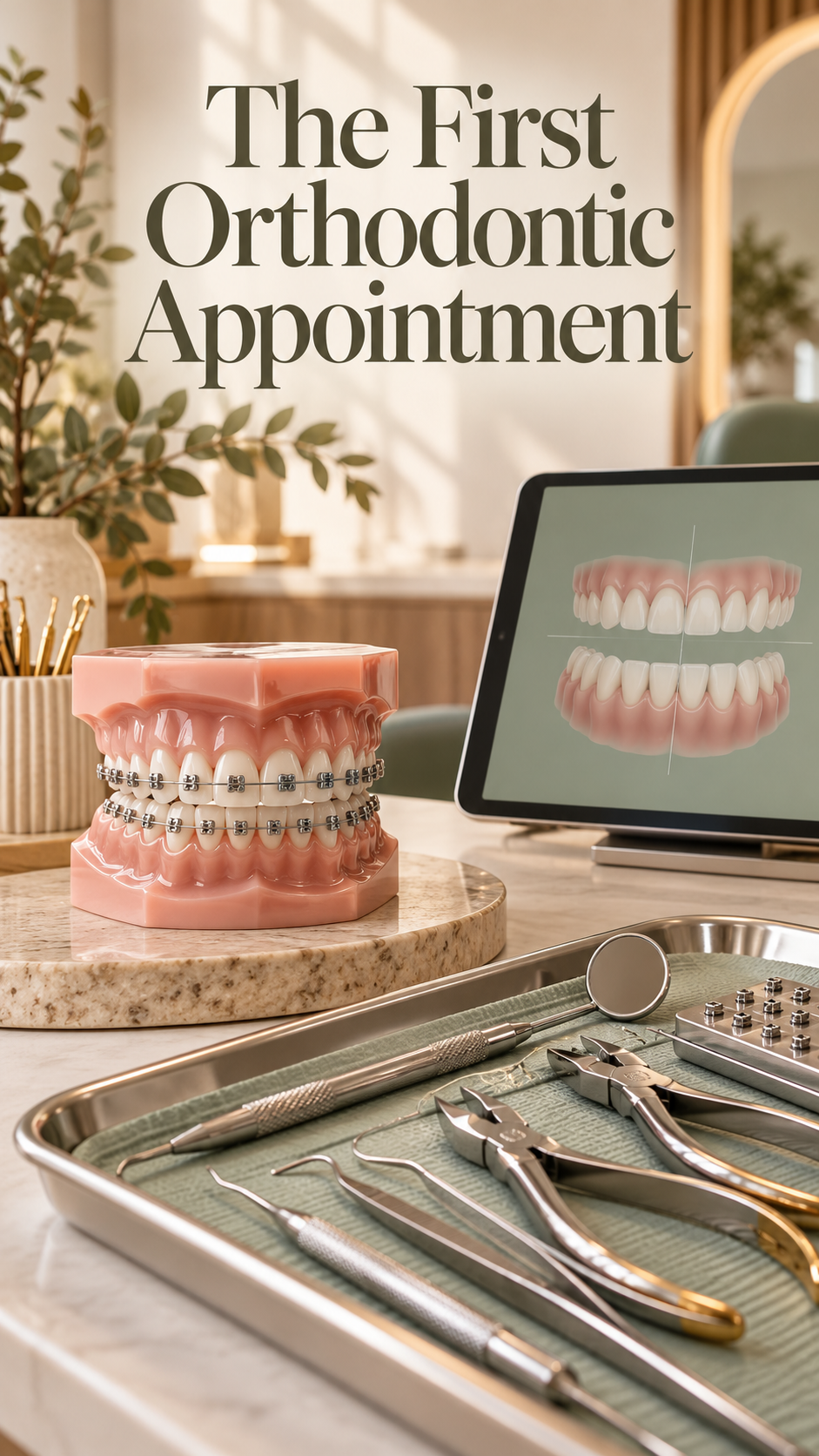
How clinical support staff prepare the room, protect trust, and hand clinical decisions to the treating professional
Orthodontic Clinician • Made for This • October 15, 2026
A first orthodontic appointment is more than a tour of brackets, wires, and aligners. It is the moment a patient begins deciding whether the team feels organized, respectful, and safe. For a beginner entering orthodontic clinical support, that makes the visit an ideal place to learn the profession: every good habit—preparation, privacy, infection prevention, careful communication, and timely handoff—appears in one patient journey.
In this series, “orthodontic clinician” is an editorial umbrella for people working in orthodontic clinical care; it is not a single nationally standardized credential. Orthodontists are dentists who complete additional specialty residency training. Clinical support staff, assistants, and technicians work within duties allowed by their state, credentials, training, employer policies, and required supervision. They do not independently diagnose, design treatment, prescribe care, or decide to adjust an appliance.
Before the Patient Sits Down
A calm appointment begins before the greeting. The room should be stocked for the planned visit, approved educational materials should be ready, and the chart should be reviewed only by team members with a legitimate need to access it. Instruments and surfaces must follow the practice’s infection-prevention process. The CDC identifies Standard Precautions for every patient, including hand hygiene, appropriate personal protective equipment, sharps safety, sterile instruments and devices, and cleaned and disinfected environmental surfaces.
Preparation is also coordination. A support team member can confirm that required records, imaging orders, consent documents, and appointment notes are available, but should not interpret findings as a diagnosis. If something is missing or inconsistent, the professional response is not to improvise; it is to flag the issue for the orthodontist or other licensed treating professional before the clinical conversation begins.
The First Five Minutes Build Trust
Patients often arrive carrying two questions at once: “What is going to happen?” and “Will anyone listen if I am nervous?” A useful opening is simple: verify identity, confirm how the patient prefers to be addressed, explain the next nonclinical step, and ask whether there is anything the team should know before beginning. For a child or anxious adult, describing the sequence—photos, scans or impressions if ordered, examination, discussion, and next steps—can make the visit feel more predictable without promising a particular treatment.
Support staff should avoid dismissive reassurance such as “It will not hurt” or “You definitely need braces.” A stronger response is: “I can explain what happens during the visit, and I’ll make sure the orthodontist hears your concern before any treatment decision is discussed.” That sentence is empathetic, accurate, and appropriately limited.
Education Without Crossing the Clinical Line
The orthodontist is responsible for diagnosis and the individualized treatment plan. Support staff may gather authorized records, reinforce instructions approved by the practice, demonstrate routine care with a model, and document questions for the treating professional. Exact permissions vary by state. DANB’s state-requirement resources and the applicable dental board should be checked before assuming that a task performed in one office or state is allowed in another.
Consider an illustrative example: a patient points to a crowded lower tooth and asks whether it will require extraction. A support team member should not predict the answer. They can acknowledge the question, record it clearly, and tell the orthodontist so the patient receives a clinical explanation based on examination and records. Good support is not having every answer; it is protecting the pathway to the right answer.
When Discomfort or an Appliance Problem Comes Up
A first visit may include questions about soreness, a previous broken bracket, a poking wire, or a retainer that no longer fits. The support role is to listen, collect the facts the practice requires, and escalate promptly. The AAO advises that loose or broken brackets, poking wires, loose appliances, and lost or distorted aligners or retainers should be reported to the orthodontist. Heavy or uncontrolled bleeding, trouble breathing or swallowing, major facial trauma, a knocked-out permanent tooth, or severe pain with swelling or fever can require urgent medical or dental care.
This is not an invitation for an unlicensed employee to diagnose pain, adjust braces independently, or recommend medication. Practice-approved temporary comfort information may be shared only within training and policy, while the treating orthodontist determines individualized care. When the symptoms sound unusual, persistent, or severe, the safest workflow is a fast clinical handoff—not a confident guess.
Consent, Privacy, and the Close of the Visit
The ADA’s ethics guidance centers patient involvement and confidentiality. In daily workflow, that means explaining nonclinical steps before proceeding, using private spaces for sensitive questions, and not discussing a patient’s treatment where unrelated visitors can hear. Photos, records, and messages should be handled through the practice’s authorized systems and permissions. A support team member can help the process move smoothly, but informed treatment discussion belongs with the responsible licensed professional.
Before the patient leaves, the team should confirm the next appointment, provide approved written instructions, document unresolved questions, and identify who will follow up. A clear close prevents the patient from carrying uncertainty home. It also gives the orthodontist a reliable record of what the patient asked, what education was provided, and what still needs clinical attention.
A Beginner’s Career Preparation Plan
A strong candidate starts with scope, not shortcuts. Review the dental board rules for the state where you intend to work, then compare education, radiography, certification, and expanded-function pathways through DANB and approved programs. Learn orthodontic vocabulary, instrument names, the difference between braces, aligners, retainers, and fixed appliances, and the practice’s infection-control sequence. Observation and supervised training should come before speed.
For interviews, be ready to explain how you would respond to an anxious patient, protect privacy at the front and back of the clinic, handle a question beyond your role, and recover from a setup mistake. Employers can teach a workflow; they look for judgment, coachability, attention to detail, and respect for supervision. Ask what training is provided, which duties require credentials, how competencies are documented, and how urgent patient concerns are escalated.
Orthodontic Clinical Care Guidebook Roadmap
Part 1 — Roles and scope: who diagnoses, who supports, and how supervision protects patients.
Part 2 — Braces comfort communication: listening, documenting, and escalating without treating independently.
Part 3 — The first appointment: preparation, patient trust, consent, privacy, and clean handoffs.
Part 4 — Brackets, wires, aligners, and appliances: terminology, setup, and practice-approved education.
Part 5 — Warning signs and urgent calls: structured intake and prompt referral to the treating clinician.
Part 6 — Retention and follow-through: retainer education, records, scheduling, and long-term coordination.
This roadmap describes planned educational development only; it does not claim that a guidebook has already been published or is available for purchase.
The Practical Takeaway
The first appointment teaches the central discipline of orthodontic clinical support: prepare thoroughly, communicate calmly, stay within scope, and move clinical questions to the professional responsible for the patient’s care. When those habits become automatic, the team feels coordinated and the patient feels seen.
To keep building a practical learning routine around patient care, organization, and professional readiness, browse the Made for This guides at https://madeforthis.blog/shop.html and choose the resource that best fits your next step.
Sources
American Association of Orthodontists — “What Is an Orthodontist? Specialized Training Explained.” Accessed October 15, 2026. https://aaoinfo.org/whats-trending/what-is-an-orthodontist-and-dentofacial-orthopedist/
American Association of Orthodontists — “What Is an Orthodontic Emergency and How Do You Handle Them?” Published February 16, 2026; accessed October 15, 2026. https://aaoinfo.org/whats-trending/what-is-an-orthodontic-emergency/
Centers for Disease Control and Prevention — “Standard Precautions.” Updated May 15, 2024; accessed October 15, 2026. https://www.cdc.gov/dental-infection-control/hcp/summary/standard-precautions.html
Dental Assisting National Board — “Ohio Dental Assistant Requirements.” Accessed October 15, 2026. https://www.danb.org/state-requirements/detail/ohio-state-requirements
Ohio Revised Code § 4715.39 — Dental assistant duties, supervision, and prohibited assignments. Current page last updated December 29, 2023; accessed October 15, 2026. https://codes.ohio.gov/ohio-revised-code/section-4715.39
American Dental Association — “ADA Ethics: Patient Autonomy.” Accessed October 15, 2026. https://www.ada.org/about/principles/code-of-ethics/patient-autonomy