
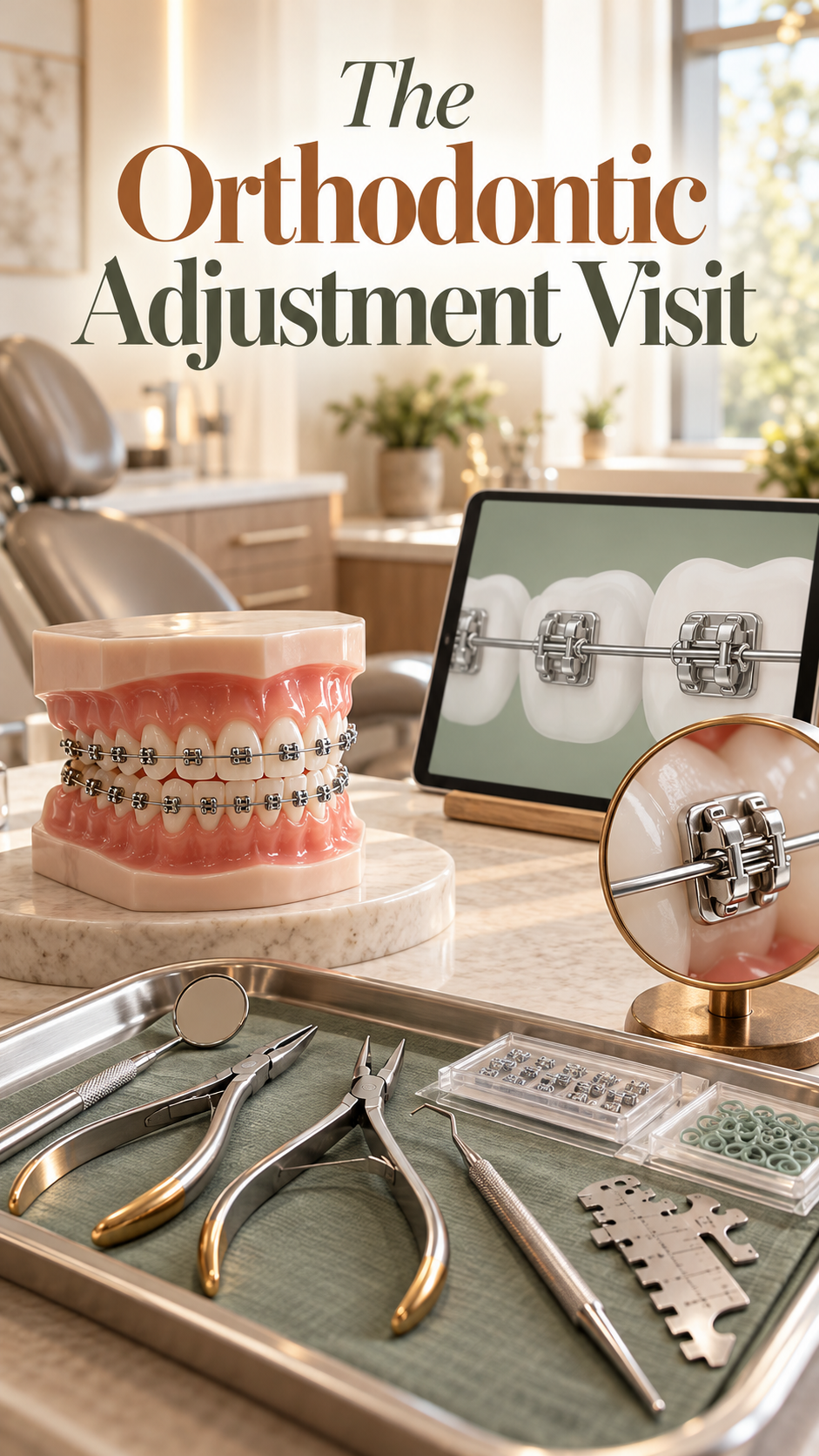
How supervised follow-up visits combine patient feedback, careful setup, and clear clinical handoffs
Orthodontic Clinician • Made for This • October 16, 2026
An orthodontic adjustment visit may look brief from the waiting room, but it carries a lot of clinical information. The patient brings weeks of experience with brackets, wires, elastics, aligners, or another appliance. The team brings the previous plan, current records, a prepared operatory, and a clear route for questions. When those pieces meet in an organized way, the visit becomes more than “tightening braces”; it becomes a supervised checkpoint in an individual treatment journey.
In this series, “orthodontic clinician” is an editorial umbrella, not a single nationally standardized credential. Orthodontists are licensed dental specialists who diagnose and direct orthodontic treatment. Clinical support staff, assistants, and technicians may perform only the tasks allowed by their state law, credentials, documented training, employer policies, and required supervision. No unlicensed team member should independently decide how to move teeth, change an appliance, diagnose pain, or prescribe care.
Preparation Starts With the Plan, Not the Pliers
Before the patient arrives, the team reviews the scheduled procedure, the orthodontist’s prior notes, unresolved concerns, and any needed materials. The goal is not to predict the next clinical decision. It is to make sure the orthodontist can evaluate the patient without searching for a missing item or reconstructing an incomplete handoff.
The operatory must also be prepared through the practice’s infection-prevention system. CDC guidance describes instrument reprocessing as a sequence that makes reusable patient-care items safe for reuse, and it calls for changing barriers or cleaning and disinfecting clinical contact surfaces between patients. A clean-looking tray is not the standard by itself; the standard is a documented process, correct products, manufacturer instructions, and a clear flow from contaminated to clean areas.
Patient Feedback Is Clinical Information
A useful adjustment-visit check-in is specific and nonjudgmental. Ask what has changed since the last appointment, whether any bracket, wire, band, aligner, or retainer feels loose or damaged, and whether the patient has had irritation or discomfort that is not improving. If elastics or aligners are part of the plan, staff can document what the patient reports about wear without shaming them. Accurate information helps the treating orthodontist decide what to examine and discuss.
The support team should separate observation from interpretation. “The patient reports a sharp edge near the upper-left back tooth” is a useful note. “The wire is wrong and needs to be cut” is a treatment conclusion. In an illustrative situation, a patient says one tooth feels unusually painful. The support team member listens, records when it began and whether swelling or appliance damage is present, and alerts the orthodontist promptly instead of diagnosing the cause.
What Happens During the Supervised Visit
The orthodontist evaluates progress, checks the health of the teeth and gums, and determines whether the current plan should continue or change. Depending on the case, the visit may involve a new archwire, different elastics, replacement of a damaged component, delivery of new aligners, or no appliance change at all. The decision is individualized; a calendar interval does not replace a clinical assessment.
Support staff may assist with setup, charting, isolation, instrument transfer, approved patient education, and other delegated duties that are lawful for their role. Some states recognize different assistant levels, certificates, radiography qualifications, or expanded functions. DANB’s state-requirement resources and the applicable dental board should be checked before treating a task as routine. A skill observed in another office is not automatically authorized in a new state or role.
Communicating Discomfort Without Practicing Medicine
The AAO explains that pressure or tenderness can occur after braces are placed or adjusted, while ongoing or severe pain, a broken bracket, or a damaged wire deserves contact with the orthodontist. The clinical support role is to communicate the practice’s approved general expectations, make sure the patient knows how to reach the office, and elevate anything unusual. It is not to promise that pain will be minor, select medication for the patient, or independently alter the appliance.
Warning signs require a different level of urgency. Heavy or uncontrolled bleeding, difficulty breathing or swallowing, major facial trauma, or a knocked-out permanent tooth can require immediate medical or dental care. A loose bracket, poking wire, loose appliance, or cracked aligner may not be life-threatening, but the orthodontist still needs to know so the office can decide whether the patient should be seen sooner.
A Clean Handoff Closes the Loop
At the end of the visit, the record should reflect the patient’s concern, the orthodontist’s direction, the authorized care performed, the education provided, and the planned follow-up. Sensitive details belong in the approved record system, not in hallway conversation or personal messages. ADA ethics guidance emphasizes patient involvement and confidentiality; in practice, that means protecting records and making room for the patient to ask questions before leaving.
The best close is brief and concrete. Confirm the next appointment, repeat only the instructions approved for that patient, identify whom to call if something changes, and document anything still awaiting the orthodontist’s response. This protects continuity when a different team member answers the next phone call.
What Beginners Should Practice First
A candidate preparing for orthodontic clinical support should learn the names and purposes of brackets, archwires, bands, ligatures, elastics, aligner attachments, retainers, and common fixed appliances. Pair that vocabulary with infection-control fundamentals, accurate charting, privacy, and state-specific scope rules. Speed matters later; reliable preparation and safe handoff matter first.
For an interview, be ready to explain how you would respond if a patient reports unexpected pain, how you would handle a task you have not been trained or authorized to perform, and how you would protect privacy in a busy clinic. Strong answers show empathy and boundaries: listen, document, notify the responsible clinician, follow approved protocols, and ask for supervision when needed.
Orthodontic Clinical Care Guidebook Roadmap
Part 1 — Roles and scope: who diagnoses, who supports, and why state rules matter.
Part 2 — Braces comfort communication: general education, careful listening, and timely escalation.
Part 3 — The first appointment: preparation, consent, privacy, and patient trust.
Part 4 — The adjustment visit: appliance setup, patient feedback, supervision, and clinical handoff.
Part 5 — Unexpected appliance problems: structured phone intake and warning-sign escalation.
Part 6 — Retention and long-term coordination: retainer education, records, and follow-through.
This roadmap describes planned educational development only. It does not claim that a complete guidebook has been published or is currently available.
The Practical Takeaway
A strong adjustment visit depends on disciplined teamwork: prepare from the documented plan, listen without judgment, keep observations separate from diagnosis, perform only authorized duties, and close with a precise handoff. For a beginner, that pattern is the foundation of trustworthy orthodontic clinical support.
To build a learning routine around professional readiness, organization, and patient-centered habits, browse the Made for This guides at https://madeforthis.blog/shop.html and choose the resource that best supports your next step.
Sources
American Association of Orthodontists — “What to Expect During Orthodontic Treatment: Timeline, Pain, and What’s Normal.” Accessed October 16, 2026. https://aaoinfo.org/whats-trending/what-to-expect-during-orthodontic-treatment/
American Association of Orthodontists — “Do Braces Hurt? Managing Orthodontic Discomfort.” Accessed October 16, 2026. https://aaoinfo.org/whats-trending/do-braces-hurt-your-comprehensive-guide-to-managing-orthodontic-pain/
Centers for Disease Control and Prevention — “Sterilization and Disinfection.” Updated May 15, 2024; accessed October 16, 2026. https://www.cdc.gov/dental-infection-control/hcp/summary/sterilization-disinfection.html
Dental Assisting National Board — “Ohio Dental Assistant Requirements.” Accessed October 16, 2026. https://www.danb.org/state-requirements/detail/ohio-state-requirements
Ohio Revised Code § 4715.39 — Permitted duties, supervision, and prohibited assignments. Current page last updated December 29, 2023; accessed October 16, 2026. https://codes.ohio.gov/ohio-revised-code/section-4715.39
Ohio State Dental Board — Licensing and renewal resources. Accessed October 16, 2026. https://dental.ohio.gov/
American Dental Association — “ADA Ethics: Patient Autonomy.” Accessed October 16, 2026. https://www.ada.org/about/principles/code-of-ethics/patient-autonomy